
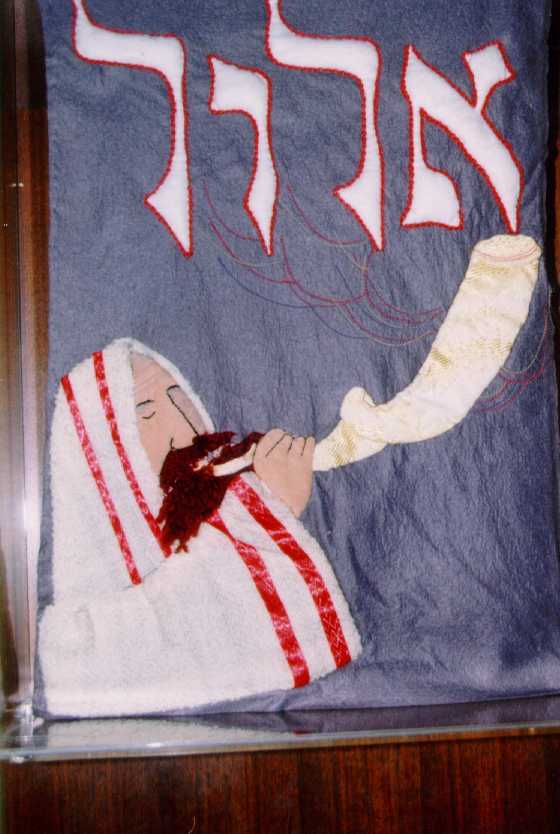
By Rabbi Alberto Sermoneta
The month of Elul is the last month of the Jewish year; it is considered a very special month, both because it is the one that precedes Rosh Hashanah and Yom Kippur—considered Yamim Noraim, days of awe—and for the importance it holds.
If we study its importance, we find interest in its meaning ever since the times of the Torah.
Indeed, this month is the one in which, after the episode of the "golden calf" and the consequent breaking of the Tablets of the Law by Moses, the punishment of those who had stained themselves with this guilt and the exceptional prayer that Moses addresses to G-d, the Lord calls Moses back to Sinai to grant the people the second Tablets.
If on the occasion of the first Tablets, during the period when Moses was on the Mountain to receive the Torah, the people said to Aaron: "Make us a leader who will walk before us..." (Exodus 32), in the episode recounting the granting of the second Tablets it is written: "carve out for yourself two tablets of stone like the first" (Ex. 34).
It should be noted that in the second Commandment, the one prohibiting idolatry by reaffirming monotheism, it is said: "Lo ta'asè lekhà pesel" "you shall not make for yourself any idol"; in the episode of the second Tablets it is said: "Pesol lekhà shenè luchot avanim" "carve out for yourself two tablets of stone".
In both episodes, and in either sense, the same term is used, deriving from a single verbal root P S L which means sculpture in one case (hence an absolute prohibition), and carve out in the other, understood as a divine imperative regarding something that must be sacred and of divine origin.
"You have no permission to sculpt divine (pagan) things, you human being have no permission to go in search of other laws or regulations, but carve out for yourself only your Tablets, carve out your heart to accept them and make your heart like stone in order to carve into it those words that will be for you your only guide."
The difference that existed between the first and the second Tablets is the manner and approach that the people had with them. In the episode concerning the giving of the first Tablets, the Mattan Torah, it is said that "the writing is the writing of G-d" and "the tablets were divine work".
There is a direct impact on a reality that the people are not yet accustomed to dealing with; they have just come out of Egypt, accustomed to living in contact with a totally different reality, amidst extreme paganism unlike any other nation. Now instead they find themselves receiving, almost as an extreme imposition, something that is divine but which on the other hand is in a totally new dimension for them.
They are therefore unable to realise their sacrality, and above all they are unable to receive something that is not on their level.
In the episode of the second tablets, there is a gradual transition from a human dimension – marble, stone, carved for a divine purpose – where later God will write with "His Own Hand" the Commandments as they were written on the first Tablets.
What connection is there between the rabbinic interpretation of the two opposite meanings of the term P S L?
In the heart of man there is the desire to create a god in his own image and likeness, who can be present when we need him, but who does not set limits on us through laws or prohibitions.
A divinity that defends our disputes without being impartial, because it belongs only to us; that guides us only when we have the need, just as Egyptian paganism, through its numerous divinities, expressed everything and the exact opposite of everything, allowing man always to behave according to his own will and selfishness without paying heed to anyone other than himself.
The Jewish people paid attention to all this only after realising the damage they had caused by having the first Tablets broken, and the impartiality of the single G-d who has no face and who is in no way representable except through behaviour towards one's fellow man and oneself.
But there is also an awareness on the part of G-d Who consents to Moses having broken the Tablets, since it was not possible for human beings, coming from four hundred years of slavery among a pagan people like Egypt, to be able to enter into a dimension of such high sacrality.
The days of the month of Elul and the subsequent ones of Rosh Hashanah and Yom Kippur must have somewhat the same function as described above because, in anticipation of this period so fundamental for us Jews, with regard to ourselves, but above all with regard to our fellow man, we have the duty to discover through this act of Pesol lekhà Carve out for yourself, within our consciences, that good and human side that makes us aware of our actions in order to be able to heal them through teshuvah, which is not repentance but the awareness of our actions.
The Selichot, which according to some traditions of our people are recited on all these nights, from the first of Elul to the eve of Yom Kippur, are an aid to bringing us to these considerations fundamental to teshuvah.
A Master of Israel writes that just as every illness needs medicine and a more or less long period to heal, so our wrong behaviour needs medicine and a period to heal; those medicines are the selichot and the period is the one that goes from the first of Elul until Yom Kippur.