
By Marco Del Monte
(30 September 2023)
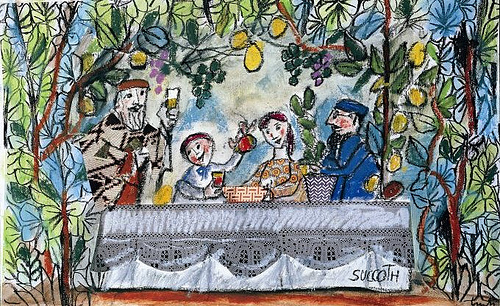
In the Midrash Rabbah it is told how Avraham hosted three angels who came to visit him, each with their own task, and had them refresh themselves under an oak tree, "Ilan". Thanks to this gesture, Kadosh Baruch Hu decided to have the people of Israel dwell in Sukkot; it is no coincidence that the numerical value of Ilan 91 is the same as the word Sukkah, but let us go further.
According to the Zohar, it seems that the oak tree of Avraham Avinu had a vitality of its own and that it recognised people who potentially believed in Hashem and people who instead devoted themselves to avodah zarah, to idolatry: to those who believed in the One G-d, the oak offered its shade and its branches turned towards that person; conversely, towards those who were firmly believers in the plurality of idols, the oak withdrew its branches and its shade. What bond, therefore, can exist between the oak and the festival of Sukkot? In a certain way Sukkot represents the festival of anti-idolatry, Hashem is One and Only even though He presents Himself in the Torah with different names and different manifestations, attributes. Sukkot teaches us precisely this: the union between different species and humility in our management of power. The Lulav represents a great lesson for modern society: the coexistence of different points of view, of different personalities, of different individualities, represented by the etrog, the myrtle, the palm and the willow; different worlds yet united, where one does not prevail over the other but rather represents the completion of the other; although each maintains its own status, the berakhah is not valid if they are NOT united, even the symbol of the etrog, which represents the element apparently "detached" from "society", from the three united species, without it, the Lulav is invalid. This idea of inclusivity and at the same time of respect towards the diversity of ideas represents a very ancient yet equally modern concept: maintaining one's individuality by detaching oneself from the other, creating divisions, splits, represents the plurality of idolatry, Hashem warns us, Be a single people with a single heart. The Sukkah represents precisely that return to simplicity, humility and union, free from "superstructures", where the only and ideal solid construction is that of trusting and letting oneself be cradled by the embrace of G-d represented by the Sukkah, a bit like returning to being children and knowing that everything we need will arrive from our parents: affection, clothes, care, food, etc. It is no coincidence that the numerical value of the word "Sukkah" is the same as Malakh, Angel, where the letters that make up the word are the acrostic of the phrase "Ki En Machsor Lireav" (Psalms 34:10) "For those who fear Him lack nothing" (as explained in Likutey Moharan Tinyana 1:6).
Perhaps, precisely for this reason Sukkot is called The Time of Our Joy!
May Hashem embrace each of us and grant us every sort of material and spiritual berakhah and never let us lack anything!
Shabbat Shalom and Happy Festival of Happiness to all!