

Written by Rabbi Alberto Sernoneta for Pesach 5769 - 2009
"Ma nishtannà ha laila ha zè miccol ha lelot?”
“How is this night different from all other nights?”
This is the part of the Haggadah that fascinates children more than all the other parts of the Seder; indeed, our Teachers maintain that it is extremely difficult for children to follow the whole Haggadah while staying awake and without getting bored.
For this reason, it has been established that both the first and the last passage of the Haggadah should be sung or recited in a language other than Hebrew, a language understandable to everyone and therefore also to children, to arouse their curiosity, but above all to try to keep them awake until the end of the dinner and the reading of the Haggadah itself.
Indeed, the first passage, the one that begins with the words “ Ha lachmà 'anijà” is not in Hebrew but in Aramaic, a symbol of the languages of the galut – the Diaspora, languages understandable to anyone.
According to rabbinic rule, it can be read in any language one wishes, precisely because it is considered the most important part of the entire Haggadah; certainly, we do not mean by this that reading it alone fulfills the obligation of celebrating the Seder!
The last passage, the one now known by most under the name of “Chad gadijà”, is also written in Aramaic, like the first, but unlike it, especially in Italian Communities, it is chanted in the dialect used within one's own family, varying from Community to Community.
It is characteristic to see how, from one community to another, even the meaning of its words changes; from the Roman kid, bought by the father for two “scudè” which was then eaten by the “cat”, to the Piedmontese “crava che pasturava” which, however, is not eaten by anyone, but causes a lot of trouble, from the broken demijohn of wine onwards.
All this up to the Israeli “chad gadijà de zabin habbà bitrè zuzè”, which is the least famous among Italian Jews, but certainly the most modern.
The curiosity that arises in us every year when singing this nursery rhyme, each according to their own local custom, and which children love so much, is great enough to make us ask why our Teachers wanted it as the final hymn of the reading of the Haggadah.
The kid: up to this point there are not many questions, it is the kid with which the korban pesach is commemorated—the Passover sacrifice that took place at the time when the Bet ha Mikdash existed, and which, according to a Talmudic explanation, symbolises the people of Israel, but what do all the subsequent phases want to tell us? Why are they repeated over and over again until exhaustion?
The prophet Isaiah, especially in the first chapters of his book, admonishes the people of Israel for their behaviour far removed from the observance of the rules of the Torah, and this will bring them ruin and disgrace.
The rod of divine wrath, “shevet af A'” as it is defined by the Prophet himself, are the other peoples who, used directly by G-d to punish Israel, will lay heavy hands upon them in carrying out this divine mandate.
For this they will in turn be punished by the Lord Himself, Who, choosing another people, will destroy the first and so on, until the repentance of the Jewish people is reached, who will be forgiven by G-d, who, then rendering justice to His people, will destroy all their enemies.
Thus it is that first the cat, then the dog, then again the water, the fire, etc., will be the instruments of divine punishment against the Jewish people, but they will then perish because the Lord God in “person”, as is said in the haggadah itself “anì ve lò Malakh, anì ve lò shaliach etc.”, will set things right, bringing justice for the extreme suffering of the people of Israel.
Every time all the rest is repeated, to ensure that we keep firmly in mind that woe betide us if we forget even a single one of our enemies and the evil they have done to us, this would be our end.
For this reason, we Jews hope from year to year that the day may finally arrive when the Eternal our G-d brings justice for all the sufferings of our people, finally bringing a just and lasting peace to Israel, and allowing us to enjoy peace and brotherhood within our people.
“Ha shatà hakhà 'avdè leshanà ha bahà be ar'aha de Israel benè chorin”
“This year here slaves, next year in the land of Israel free people”
Rhyme of “a little goat” according to the custom of the Jews of Rome
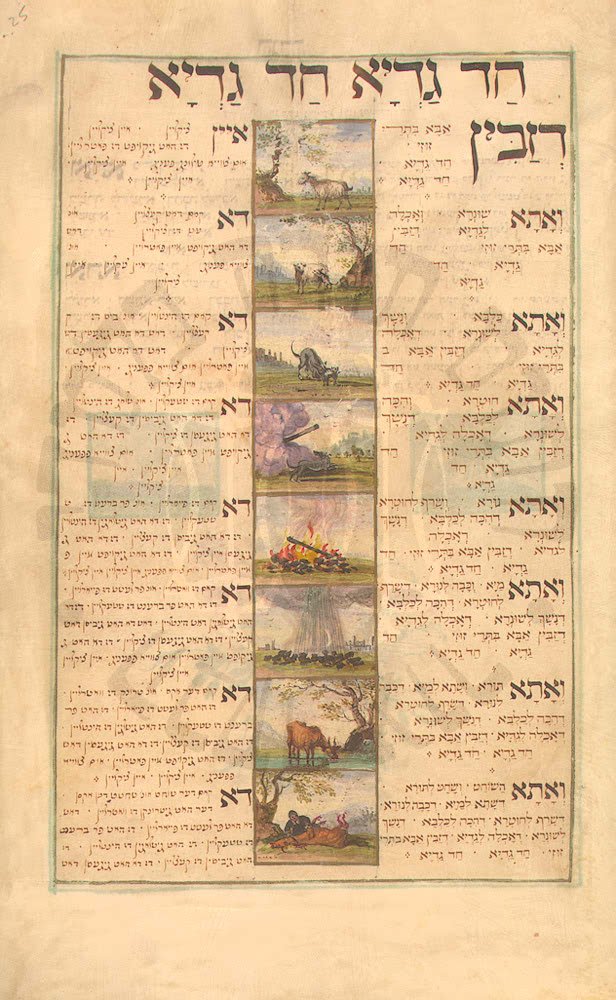 A little goat a little goat that my father bought for two scudè,
alu caprè alu caprè.
Then came the cat that ate the little goat that my father bought for two scudè alu caprè alu caprè.
Then came the dog that bit the cat, that ate the little goat that my father bought for two scudè alu caprè alu caprè.
Then came the stick that beat the dog, that bit the cat, that ate the little goat that my father bought for two scudè alu caprè alu caprè.
Then came the fire that burned the stick that beat the dog, that bit the cat, that ate the little goat that my father bought for two scudè alu caprè alu caprè.
Then came the water that quenched the fire, that burned the stick, that beat the dog, that bit the cat, that ate the little goat that my father bought for two scudè alu caprè alu caprè.
Then came the ox that drank the water, that quenched the fire, that burned the stick, that beat the dog, that bit the cat, that ate the little goat that my father bought for two scudè alu caprè alu caprè.
Then came the shochet who shechted the ox, that drank the water, that quenched the fire, that burned the stick, that beat the dog, that bit the cat, that ate the little goat that my father bought for two scudè alu caprè alu caprè.
Then came the Malakh ha mavet who shechted the shochet, who shechted the ox that drank the water, that quenched the fire, that burned the stick, that beat the dog, that bit the cat, that ate the little goat that my father bought for two scudè alu caprè alu caprè.
Then came Kadosh Barukh Hu who shechted the Malakh ha mavet, who shechted the shochet, who shechted the ox, that drank the water, that quenched the fire, that burned the stick, that beat the dog, that bit the cat, that ate the little goat that my father bought for two scudè alu caprè alu caprè.