
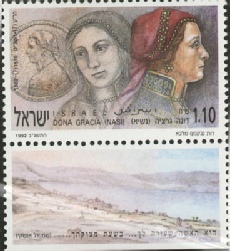
By Ines Miriam Marach
Adaptation of a lecture given at the Jewish Community of Bologna as part of the series “Women and Judaism” in April 2007.
The eventful and at times daring adventures of Donna Gracia Mendes, la Seniora, an emblematic female figure of the sixteenth century, have been a source of inspiration for many writers of adventure novels; her life was certainly a novel and her being a Marrano, that is, belonging to two such different and distinct identities, has handed her down to history as an active role model for women, perhaps a forerunner of female emancipation and a lively protagonist within the society of her time.
Beyond fictionalised accounts, which only sometimes make use of historical sources, there is no shortage, in the specific historiography on Renaissance Jewish culture and on Sephardic culture, of contributions by scholars such as Roth, Bonfil, Leoni, Yoli Zorattini, to name but a few, who have certainly reconstructed and well documented the interesting and intriguing figure of Grazia Mendes.
Roth also published a biography of her, now impossible to find, which was taken up by a scholar from the University of Urbino and published in 2004.
Who then is this woman who tried to change the destiny of the Jewish people in the sixteenth century?
Grazia Ha-Nasì was born in 1510 (or perhaps in 1511 according to some sources) in Portugal, to a family of probable Spanish origin following the Edict of Expulsion of 1492; the life path of her family group, like that of many others, was part of that event which Cecil Roth defines as the most romantic episode in human history: Marranism (the phenomenon of crypto-Judaism) which, although still quite enigmatic, indeed constitutes a fundamental and at the same time tragic chapter in the history of the Jews of the Diaspora in many countries of Western Europe, especially between the sixteenth and seventeenth centuries.
The complex identity of the Marranos (the anussim, “the forced ones”) was characterised by well-defined forms of practising religious life, based on the dissimulation of a forbidden affiliation, the Jewish one, and on the simulation of a false affiliation, the Christian one.
The term Marrano, which the Spanish historian Carobaroja intends as referring to a group of people not entirely homogeneous in time and space, is an ancient derogatory Spanish term of Arabic root, which was used to indicate a young pig, attributed first to Muslims, then to Jews, alluding to the prescription for both to consider it an unclean animal, thus associating them with it.
The use of the term started in the region of Castile in medieval times, the place where the first forced conversions occurred.
In Italy it became established in the sixteenth century with the arrival of Portuguese refugees, where it took on the common meaning of a Jew who, after being baptised, returned to being openly Jewish.
Roth makes the origin of Portuguese Marranism coincide with the phenomenon of the New Christians, which arose in Spain towards the end of the 1300.
Following the Reconquista by the Christian states, which then dominated the entire Iberian Peninsula, the condition of the Jews gradually worsened until the moment when intense Dominican preaching brought waves of violence that swept through the juderias, the Jewish quarters of Castile and Aragon; sources report the massacre of Seville, perpetrated on Ash Wednesday 1391, as the most bloody.
The life of the Spanish Jewish communities was thus irreparably compromised, and the foundations were laid for a series of limitations on the autonomy of the Jews, which within a century would lead to the expulsion of 1492, decreed by Isabella and Ferdinand after the reunification of the kingdoms of Castile and Aragon.
In this context arose the problem of the conversos, the New Christians, converted by force or spontaneously to save their lives, who constituted an element of ideological discomfort for the Christian authorities.
The Jewish exiles expelled from Spain in 1492 scattered to every corner of the Mediterranean basin; a large number went overseas, especially to Muslim countries, but also to some Italian states, albeit in a small percentage; this is what Roberto Bonfil argues, writing that their numerical strength was rather negligible except perhaps at the beginning when fairly large groups stationed in Italy in transit to the East.
But the majority crossed the border and stopped in Portugal, where Jews were still fairly tolerated, until 1497, when forced baptism was imposed;
the penalty paid for not complying with this order was expulsion.
While for some historians (Roth first and foremost) the term Marrano is synonymous with converso, according to others, the true phenomenon of Marranism, understood precisely as crypto-Judaism, spread in Portugal when almost everyone, also to save their businesses, accepted baptism while continuing secretly, in their hearts, to be Jewish.
With the introduction of the Inquisition in Portugal as well in 1536 and the consequent risk of being discovered and prosecuted, most of the Marranos left for the Netherlands (Amsterdam and Antwerp were the most important centres) and Italy.
Rome, and Ancona (in the Papal States), Venice, Ferrara and later Livorno, were the places where the Marrano communities were most concentrated.
Gracia's family, the ha-Nasì (the princes), like all Jewish refugees in Portugal, also suffered the fate of forced baptism imposed on 4 March 1497; Gracia was therefore born with the Christian name of Beatriz de Luna.
In 1528 she married Franzisco Benveniste Mendes in Portugal, a wealthy Marrano merchant but perhaps also a rabbi, with a public Catholic ceremony, preceded by a Jewish one celebrated privately in total secrecy, therefore with a regular ketubbà which also fixed her dowry.
This caused several legal complications which I will only mention for the purpose of narrating the events concerning her life and history.
Shortly afterwards followed the birth of a daughter, Reyna.
In 1536, the year of the Inquisition, Gracia was widowed at a young age.
Her husband, in a testamentary declaration before his death, entrusted his wife's fate as well as the management of half of his estate to his brother Diogo, a man skilled in business with interests in the Netherlands, who upon Francisco's death also managed and controlled all his finances.
Following the establishment of the Inquisition, Gracia left Portugal with her daughter Reyna, her nephew Joao Miguez (alias Yosef ha-nasì), her sister Brianda and some other family members, bound for Antwerp, where the Portuguese Marrano community
(predominantly spice merchants) found refuge in part.
In Antwerp, Gracia had contact with the physician Amato Lusitano (alias Giovanni Rodrigo Amato), whom she would later also meet in Venice and Ferrara.
After this first transition, the desire and the plan to return openly to Judaism was already maturing in her.
Shortly after the transfer of assets to Antwerp, Gracia worked alongside her brother-in-law, demonstrating great entrepreneurial ability and establishing alliances with the wealthiest families in the Netherlands, so much so that she was proposed by high circles an arranged marriage between her daughter Reyna and a Christian scion, a request which she categorically refused, but for which she had to pay by fleeing Antwerp.
Grazia's ties with her husband's family became increasingly close when in 1540 Diogo Mendes married her sister Brianda, with whom he had a daughter.
Diogo issued a document in which Grazia and her daughter benefited equally from Francisco's estate. Upon Diogo's death in 1542, Gracia became the administrator of the Mendes estate, which greatly annoyed her sister.
In 1546, Grazia left Antwerp and, passing through Lyon, arrived in Venice, a melting pot of peoples and cultures where the Sephardic migratory wave was predominantly Marrano; in 1541, in fact, the ghetto vecio was created for Levantine Jews temporarily residing in the city, who were actually former Marranos who had returned to Judaism in the Turkish Empire. Here the dispute broke out between Gracia and her sister over the Mendes estate, which ended with Brianda denouncing her to the Venetian authorities on charges of being a Judaizer.
After being imprisoned, Gracia, or Beatriz as one may wish to call her, reached Ferrara in 1549, an important point of reference for all exiles, asking the regents for guarantees for her stay, and where she began her journey of return to Judaism.
In Ferrara, the clemency of the Estensi towards the Jews was well known; indeed, within a few years they had transformed their territories into places of refuge to attract Portuguese merchants from Antwerp and Turkey, a trend already concretised with the arrival of exiles from Spain first and those from Bohemia in 1532, to whom were granted the same privileges (concerning above all the conduct of their businesses) as the already established Italian group.
It is difficult to understand when the first Portuguese Marranos arrived (mostly merchants, but also physicians, rabbis, artisans), probably between 1531 and 1536 when the Inquisition was definitively established in Portugal.
Nel 1538 Ercole II, che confermò i decreti già emessi dai suoi predecessori in favore degli ebrei spagnoli, delegò al marchese Moreto “ampia facoltà e piena autorità di poter convenire circa li datii et franchigie … con tutti li singuli spagnoli et parimenti Con tutti i singuli che haverano la lingua spagnola e con tutti i singuli che haverano la lingua portugallese…”
This was the climate that Gracia found upon her arrival in Ferrara; during the brief period of her stay, as already mentioned, she abandoned her Christian identity and returned to Judaism, studying traditional texts under the guidance of Rabbi Soncino.
Important for her Jewish education was her friendship with Benvenida Abravanel, thanks to whom she approached the study of Jewish mysticism.
But for both Gracia and all the other Marranos who arrived in Ferrara and other Italian cities, the condition of double religious identity had certainly created many problems, psychological and spiritual distress that disrupted the life of every single individual.
“Il marrano giudaizzante (cito lo storico Yovel) visse in alienazione non solo nell’ambiente cristiano ma anche nella propria intima essenza, che non poteva esprimersi nella sua vita attuale; e così, in effetti la sua vita e la sua natura rimasero in reciproca opposizione”.
Gracia therefore perceived these difficulties, experiencing them herself, and worked to alleviate the suffering of her coreligionists, helping them to emerge from hiding and recover their religion of origin; she became a benefactress of the community, cooperating to establish Sephardic culture, which already had great exponents such as the humanist Abraham Farissol and the Abravanel family, Isaac and Yehudà Abravanel, philosopher and exegete also known as Leone Ebreo, who arrived in Ferrara from the Kingdom of Naples after 1542.
In particular, the collaboration that Gracia had with the printer Avraham Usque was fruitful, to whom she offered her financial availability to publish works translated from Hebrew into Judeo-Spanish, in order to make them accessible to the Sephardic population, in particular to the Marranos who were about to return to Judaism.
In particular, a translation of the Bibbla in lengua espagnola (later known as the Ferrara Bible, of which two dedicated copies still exist, one to Gracia and the other to Ercole II), which was followed by a Lybro de Oracyones de todo l’anno which Avraham Usque also published with Yom Tov Attias.
Avraham Usque together with Shemuel Usque (whose relationship is not established) were two representative figures of the Ferrarese Sephardic culture of the time.
They too enjoyed the privileges granted by the regents of the House of Este, which allowed them not only to be the promoters of Ferrarese printing activity but also to be intermediaries between the Estensi and the Portuguese nation; not for nothing did Shemuel Usque define Ferrara as the safest port and identified in the protection of Ercole II “the path that leads to the final consolation of Israel”.
Shemuel also published a text in the Portuguese language “consolacao as tribolacaoens de Israel” (Consolation for the Tribulations of Israel), a metaphorical narrative of the troubled history of the Jewish people.
Ercole II was also a key figure in the life of Gracia and of all the Ferrarese Marranos, as he was also regarding the events of Ancona which will be discussed later.
On 23 April 1555, while persecutions were raging in Ancona, Ercole II, at the specific request of Gracia, issued a decree in the form of a safe-conduct to some Portuguese and Spanish refugees to whom he granted the same concessions that the popes had granted to the Portuguese of that place.
This decree by Ercole II was followed by a second one which invited the Levantine merchants of Ancona to leave the city, promising them a welcome, motivated by the desire to “empir questa nostra cittade di mercanti spetialmente di quella natione”.
However, it does not seem that the influx of Portuguese from Ancona to Ferrara was significant.
Historians are, however, in agreement in stating that the two decrees of Ercole II are to be interpreted as an open and courageous rejection of the repressive policy of Paul IV, who seemed to combine in himself the most fanatical aspects of the Counter-Reformation, being also the promoter, with the issuance of the Bull Cum Nimis Absurdum, of the establishment of the ghettos and advocate of the revocation of the privileges granted by his predecessors to the Portuguese Marranos of Ancona, who were the first to suffer from his religious zeal.
On 30 April 1556, he withdrew the letters of protection he had granted, hoping to make Ancona the sorting centre for trade with the Levant, and ordered immediate measures against them.
The Marranos therefore arranged for the collection of money to obtain a truce, but all was in vain.
Among all those prosecuted, on charges of being Christians and of Judaizing in private,
25 of them, 24 men and one woman (Donna Mayora), were sent to the stake.
It was useless for them to deny ever having received baptism.
Everyone knew that in the last 60 years no declared Jew had been able to live in Portugal. Another 26 feigned repentance and were deported to Malta, the remainder finding refuge outside the Papal States.
At the time of the events in Ancona, Gracia and her daughter, who in the meantime had married her cousin Joao Miguez (Yosef ha Nasì), had left Ferrara and had already moved to Constantinople; integrated both within the court of Sultan Selim II and the Jewish community, they did their utmost to renew and reinvigorate it with the establishment of synagogues and academies of learning and other social activities.
This important role of hers favoured the intervention of the Sultan, who on 9 March 1556 addressed an arrogant letter to Paul IV in which he protested against the inhuman treatment of the Marranos, some of whom were his subjects, and demanded their release.
The events that followed seem to be unique in history. Grazia Mendes realised that the only weapon the Jews possessed to oppose the Pope's hatred was an economic one; with the help of the Sultan, she organised a complete boycott of the port of Ancona, diverting all mercantile and commercial trade with the East to Pesaro.
According to Roth, the attempt failed mainly because the Jews of Ancona appealed to revoke the decision, which would have unleashed the Pope's hatred against them. And even worse, the Duke of Urbino, who saw his dream vanish, decreed the expulsion of the Marranos from his territories.
Regarding Gracia's intervention in Ancona, Ioshua Soncino, a well-known rabbinic authority of the time and her tutor in Ferrara, wrote:
“La signora incoronata, il glorioso diadema delle genti d’Israele, vita signorile, gloria incoronata, bella ghirlanda, la più saggia delle donne d’Israele, con la sua forza e ricchezza tese una mano ai poveri per salvarli e renderli felici in questo mondo e nel prossimo”.
To conclude, it does not seem to me hazardous to relate the figure of Grazia to Esther. Both change the destiny of their people; Esther saves them from the extermination decreed by the wicked Haman, Grazia, whose Hebrew name after her definitive return to Judaism was Hanna (a name composed of the initials of the three mitzvot of a woman, challah, nerot and niddah, with which she seems to want to assert her Jewishness), fights for the salvation of the Portuguese Marranos, winning the distinction of being the most beneficent and beloved woman in the Jewish world of that time.
In the aforementioned text by Shemuel Usque, the author himself states that if Grazia had not left Portugal and had not carried out her mission in favour of the Marranos, the history of the Jewish people of that period would have been different.
Brief Bibliography
General works
C. Roth, Storia dei Marrani, ristampato da Marietti edizioni, Milano 2003
B. Netanyahu, The Marranos of Spain, New York 1966
R. Bonfil, Gli Ebrei in Italia nell’epoca del Rinascimento, Sansoni Editori, Firenze 1991
A. Leoni, La Nazione ebraica spagnola e portoghese negli Stati Estensi, Luisé editore, Rimini 1992
Gli Ebrei in Italia, a cura di C.Vivanti, 2 vol., Einaudi,Torino 1996-97
L’Inquisizione e gli ebrei in Italia, a cura di M.Luzzati, Roma- Bari 1992
Y.H. Yerushalmi, Dalla Corte al Ghetto. La vita, le opere, le peregrinazioni del marrano Cardoso nell’Europa del 600, Milano 1991
Opere specifiche sui conversos
Ebrei e cristiani nell’Italia medievale e moderna. Conversioni, scambi e contrasti,
A cura di M. Luzzati, M. Olivari e A.Veronese, Roma 1988
L’identità dissimulata: Giudaizzanti iberici nell’Europa cristiana dell’età moderna,
a cura di P.C. Yoli Zorattini, Firenze 2000
Ebrei: identità e confronti, “Zachor, V (2001-2002)
I. Yovel, Spinosa and other Eretics, 2 vol. Princeton 1989
Specific works on Donna Grazia Mendes
C. Roth, Danna Grazia Ha Nasì ed il Duca di Nasso (no longer available)
M.G. Muzzarelli, Beatrice de Luna, vedova Mendes, alias Donna Grazia Nasi: un’ebrea influente. In Rinascimento al femminile, pp. 83-116, Editori laterza 1991
M. Racanelli, Grazia Mendes, L’identità marrana al femminile, Ancona 2004