
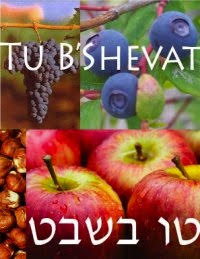
Tu Bishvat (or Rosh Hashanah la-Ilanot) is a holiday also known as the New Year for Trees.
EVE FRIDAY 22 JANUARY
Lighting of Shabbat candles 16.51
Kabbalat Shabbat and Arvith 18.00
If desired, you can contribute with a free donation.
To book, write to the Secretariat.
The origins of Tu BiShvat
The name of the festival means 15th of the month of Shevat, which is the central day of the Jewish month of Shevat. This year too, at the beginning of summer, we will reluctantly have to submit our tax return. And we will do so by gathering all the documentation of what we earned and spent in the previous year, from 1 January to 31 December. What comes before and after these dates does not matter. Only the tax year matters, which begins and ends at specific times.
Strange as it may seem, the observance of Tu BiShvat, the 15th of the month of Shevat, is closely linked to the concept of the tax year. Taxes were paid in ancient Jewish society too, and this is certainly no surprise. The calendar was divided into seven-year cycles, and in each year a "tithe" on agricultural produce had to be levied. The "first tithe" was due every year to the Levites. A second tithe was applied to the produce remaining after the levy; in the first, second, fourth and fifth year this tithe remained with the producer, but with the obligation to consume it (directly or in its equivalent economic value) in Jerusalem; in the third and sixth year instead it was given to the poor. It should be noted in passing how the amount of these taxes was much more modest than those imposed on us by a modern state.
It was therefore important to establish which year a certain produce belonged to; if for example it was from the second year, it remained with the producer with the obligation to take it to Jerusalem, if it was from the following year it had to be given to the poor. But how was it assessed whether a produce belonged to a certain year? And furthermore: the Torah forbids eating fruits produced in the first three years of a tree's life (orlah): but how do you calculate the age of a tree and a fruit? It is necessary to establish dates for the beginning of the year, which are closely linked to the agricultural cycle. The new year for tree fruit is considered to be the moment when buds begin to form after the winter break. Every fruit that was born (or that has begun to ripen, according to some opinions) before the date established as the new year belongs to the previous year, if it was born after it is from the current year.
In the climate of the Land of Israel, the (fiscal) new year of the trees is closely tied to the time when most of the rainfall (which occurs almost entirely in autumn and winter) has passed. The Mishnah (the first in the tractate of Rosh HaShanah) indicates the various new years of the Jewish calendar and reports, regarding trees, a divergence between the school of Shammai and that of Hillel; the former set the new year on the 1st of Shevat, the latter on the 15th. The rule, as we know, follows the opinion of Hillel, so it begins on the 15th. But if it is a date tied to the flow of rain, it is difficult to understand the reasons for the disagreement between the two schools. A recent study, based on current rainfall data - which are presumed not to differ much from those of two thousand years ago -, explains that in Eretz Israel there are very different climatic zones; throughout the coastal plain the heaviest rains end by the date set by Shammai, whereas in the Judean hills and in Jerusalem in particular the date is shifted forward by 15 days. This practically means that we set the fiscal calendar of the trees based on the climate of Jerusalem.
When people talk about taxes, and even more so when they pay them, they are not very cheerful, and in principle it is not understood why, after all, Tu BiShvat became a minor festival. There are various explanations for this. First of all, taxes are not paid on Tu BiShvat, but after the harvest has taken place; when celebrating a new year, whichever one it may be, people are cheerful and do not think that it is the beginning and the end of a fiscal year, but rather they hope that the harvest or the earnings of the year that is beginning will be better than those of the previous year.
Apart from this, the history of the celebration of Tu BiShvat shows a certain evolution and indicates that it took a long time before special ways of remembering and celebrating this day were created. As a minor festival it has always been a day when work is permitted, but certain manifestations of sadness are forbidden, such as funeral prayers or the reading of tachannun. But it took a long time to arrive at forms of active celebration, and in this the contribution of the kabbalists of Safed in the sixteenth century was decisive. The simplest and most ancient custom, probably dating back to the early Middle Ages and now widespread throughout the world, is to eat fruit of various kinds on this day, in particular the produce of the tree for which the Land of Israel is praised in the Torah: grapes, figs, pomegranates, olives, dates; in addition to these, other fruits mentioned in the Bible, such as almonds, pistachios, walnuts, tappuchim (which in the Bible are not apples, as is commonly believed and as modern Hebrew indicates today, but rather citrus fruits), and then any other kind of tree fruit.
A genuine rite dating back at least to the early eighteenth century is documented for the first time in the kabbalistic work Chemdat Yamim, and consists of a sort of Seder (or Tikkùn) in which the consumption of various fruits, in a special order, and of wine (white and red) alternates with the reading and commentary of biblical, rabbinic and mystical literature passages. This rite, long forgotten in Italy, has recently been reintroduced by Rav Shalom Bahbout, who also supervised the printing of the text with Italian translation and commentaries: two editions have already been released, the first in 5746 (1986): Seder Tu Bishvat per il Capodanno degli alberi, the second (Lamed editions) in 5760 (2000); our public has welcomed this reintroduction and nowadays the Seder is held in many families.
Other ways of commemorating this day are tree-planting ceremonies; they began in Eretz Israel in the first decades of the last century, as a testimony of attachment to the land and of the importance of the resumption of agricultural life, and of reforestation in particular. Perhaps the influence of American culture (arbor day) was not extraneous, but in any case, specifically internal positive values prevailed in Jewish society, connected to the relationship with Eretz Israel, its reconstruction, and the traditional importance of trees, especially fruit trees. To educate about these values, the custom in many places, even outside Eretz Israel, is to symbolically plant a tree on Tu-bishvat.
Symbolic meanings
When remembering Tu-bishvat, some very important ideas in the Jewish consciousness are recalled and emphasized.
The relationship with hidden realities: Jewish mysticism speaks of realities that are invisible to us, which it often compares to a tree, just as it compares the various forms of fruit (edible peel or not, hard or soft core, etc.) to symbols of different worlds. The "peel" (qelippà) is also a symbol of evil. For this reason, the kabbalists propose a symbolic journey between the different fruit species and the colours of wine, suggesting a journey among different worlds, between Justice and Mercy, with the intention of contributing to repairing (tikkùn) the visible world where we live. These are messages and teachings that, to be understood, require special knowledge and sensitivity, but which cannot be neglected amidst the wealth of symbols that this day offers to the Jewish community.
How to remember Tu-bishvat
- Those who wish to do so should look for the text of the Seder, available in bookstores, and follow it by procuring all the necessary ingredients (wines and fruit), or join friends who are already organized to do it.
- In any case, do not neglect the tradition of eating different types of fruit, at least at one meal during the day. It is important to eat and to bless. When eating fruit, the borè perì ha’etz blessing is recited first (Creator of the fruit of the tree), which takes on a special meaning at this time. The blessing is also recited if fruit is eaten during the meal, after already saying the hamotzì. After eating, if the meal included bread, fulfilling the obligation is covered by the birkat hamazon. Those who have instead eaten only fruit recite a special blessing at the end: ‘al ha’etz we’al perì ha’etz etc. for grapes, figs, pomegranates, olives and dates; borè nefashòt for all others (the texts are printed in the tefillot and in common birkhonim).
Article published by KKL and written by Rav Riccardo Di Segni