
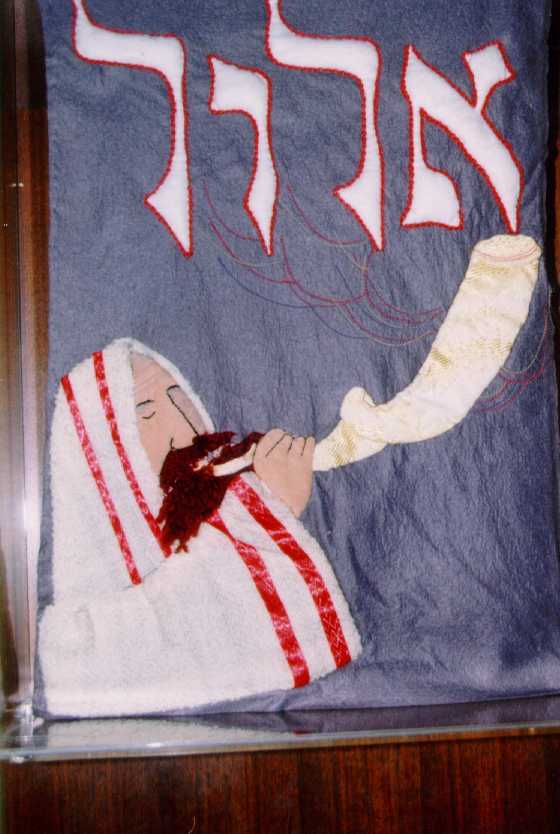
By Rabbi Alberto Sermoneta
The month of Elul is the final month of the Jewish calendar, the month that precedes the great day of Rosh Hashanah.
For this reason it is known by rabbinic tradition as chodesh ha selichot ve ha rachamim, meaning the month of supplications and mercy. There is an exchange between us and G-d, towards whom we direct our supplications and He acts towards us with mercy.
The term rachamim is translated as mercy, but it aims to mean something much deeper, which only we Jews have managed to interpret, as our tradition has always guided us to understand the deepest paths within our hearts.
If analysed grammatically, rachamim can be defined as the plural of the word rechem, which means womb, maternal belly; a characteristic common to all women who have brought children into the world is that of understanding their innermost feelings and even helping and understanding them even when they make mistakes, and most of the time, forgiving them.
This is also the divine characteristic, as G-d is able to understand the actions of His "children" and even to forgive them at times when they make mistakes, because He loves forgiveness and not punishment.
The month of Elul has the power to ensure that G-d, through the supplications we direct to Him, can forgive us for our faults and past transgressions committed during the year, of which we have truly repented, not only in words but also through deeds.
"Lo ha midrash hu ha ikkar ellà ha ma’asè", " chatter is not the fundamental thing, but the deed" the Masters of the Mishnah admonish us! That is to say, it is not promises in words, those we make when we find ourselves in the critical moments of our lives, but what we manage to keep that is the fundamental thing!
A midrash recounts that when the king of a place decides to go down to meet his subjects, to hear their needs and see what they do for him in the fields of work, every subject and every worker tries to secure the place closest to the path the king will take, so as to ask him for what he needs and have a greater probability of being heard.
This is what we Jews must do during the month of Elul, that is, the month in which the Lord is closest to His people, to see their work and hear their requests, and that is why we must take advantage of this opportunity given to us once a year.
Throughout the month of Elul, it is customary to get up very early in the morning, when it is still dark (many use to do it in the middle of the night) and recite a series of prayers and supplications called SELICHOT, in which, in addition to asking G-d for forgiveness for everything not good we have done during the course of the year that is coming to an end, we also ask for what we need to live a good and dignified life that can put us in the condition to serve Him alone and no one else, much less our fellow men.
The characteristic of these selichot is precisely the time at which they are recited, namely in the depth of the night, almost highlighting the fact that at that hour most men use to sleep, and almost symbolising that the Lord is less intent on His activity and therefore has more time to listen to the prayers of the people of Israel, who are particularly dear to Him.
It looks like a little picture describing a love idyll in which two lovers meet in secret, not so much to keep things hidden from others, but not to create reactions of jealousy on the part of other peoples.
A famous master of the last century, commenting on the period of selichot and thus of the month of Elul, said that just as every physical illness of the human body needs a more or less brief period of treatment so that the body can regain its strength and face everyday life anew, so too the soul needs treatment to heal from its illness and return to living healthily.
One of the worst illnesses of the soul is LASHON HA RA’ that is speaking ill of one's neighbour; it is not only gossiping but also alluding to something negative or even insinuating bad behaviour by one's neighbour, reported to a third person.
It is considered among the worst categories of guilt with which the people can stain themselves; it is punished not with sudden death, but with illnesses that lead to a high degree of suffering, until he who is stained with such guilt can realise the damage he has caused to his "brother".
If one thinks of the story of Miriam, sister of Moses, who for having merely insinuated something true regarding her brother, is struck by this atrocious illness that harms her not only physically, but also morally and psychologically.
This period of treatment coincides with the month of Elul, with the selichot and all the other actions that every Jew has the duty to perform and which are no less important than the latter.
Our Masters urge us, in addition to selichot, to carry out other mitzvot fundamental to our healing, which are:
Teshuvah, not repentance but return, that is, the return to that path indicated by the Torah which allows us not to run the risk of erring or transgressing.
Tzedakah, not almsgiving but the work of justice that every Jew has the duty to observe towards anyone who may ask for it. Every Jew, both rich and poor, has the duty to do tzedakah so that within the people of Israel there are no disparities in behaviour towards the Lord God.
Tefillah, not only prayer, but the willingness to submit oneself to divine judgement, accepting the consequences of one's behaviour.
Only in these conditions can we face that great and terrible day which is Rosh ha Shanah, called by the Masters of Israel Yom ha Din – day of judgement – in which each of us must give justification for our actions before Him who is Chaj ve Kajam (living in eternity) and who has all the creatures of creation pass before Him to be analysed, and who takes no bribes nor shows partiality.
Therefore let us take the teaching of that Master who says that just like every bodily illness, those of the soul also need to be treated, and let us take advantage of the treatments at the time when THE KING IS IN THE FIELD and is most willing to listen to our needs